
News / Blog
Fiberglass Fabric Weaving Type Introduction
Made of fiberglass yarn and air jet loom, Fiberglass Fabric is an inorganic non-metallic material with excellent properties. It has good insulation, heat resistance, good corrosion resistance and high mechanical strength.
Common Fiberglass Fabric weave types are as follows:
- Plain Weave

The plain weave consists of yarns interlaced in an alternating fashion, one over and one under every other yarn. The plain weave provides good fabric stability. It is the primary fabric used in the electronics and coating industries.
- Basket Weave

The basket weave is similar to the plain weave, except that two or more filling yarns are alternately interlaced over and under each other. The basket weave is more pliable, flatter, and stronger than the plain weave, but is not as stable.
- Leno

The leno weave is used where relatively low numbers of yarns are involved. The leno weave locks the yarns in place by crossing two or more warp threads over each other and interlacing with one or more fill threads. Light weight membrane Applications use the leno weave.
- Four-Harness Satin (Crowfoot)

The four-harness satin weave is more pliable than the plain weave and is easier to conform to curved surfaces typical in reinforced plastics. In this weave pattern there is a three by one interlacing, where a fill yarn floats over three warp and under one.
- Eight-Harness Satin

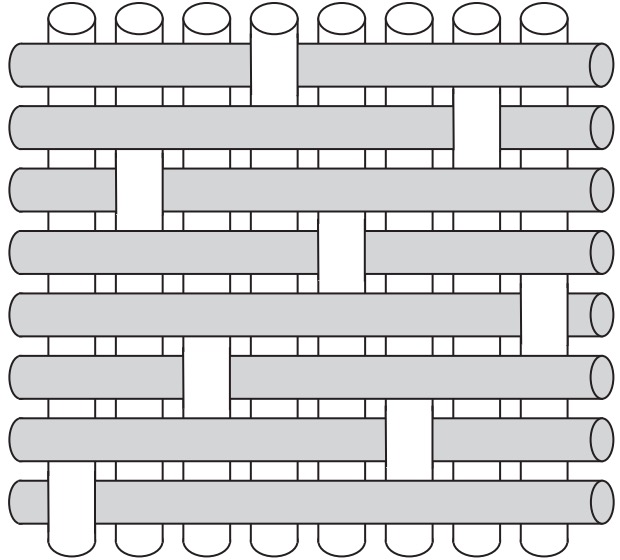
The eight-harness satin is similar to the four-harness satin except than one filling yarn floats over seven warp yarns and under one. This is a very pliable weave and is used for forming curved surfaces. It is generally produced in the 6 oz/sqyd to 18 oz/sqyd weight range.
- High Modulus Weave

The high modulus weave is used where high impact resistance and high strength are required. The weave eliminates the interlacing of structural yarns, thereby reducing crimp and shear factors. This special weave is the most pliable and conforms most readily to highly contoured planes. - 2×2 Twill

The twill is used where tightly woven fabric with high density is required. The twill weave is characterized by a diagonal rib or twill line. The warp yarn floats over at least two consecutive picks, permitting more yarns per unit area.